The $16 Billion Trust Problem: Why Online Payments Need a Middle Layer
The Hidden Risk of Direct Payments: Why Paying a Stranger Directly Exposes Both Buyers and Sellers
Online commerce has made it possible to buy from almost anyone, anywhere, within seconds. A buyer sees a product, contacts the seller, receives bank or payment details, transfers the money, and waits for delivery.
It feels efficient.
It is also one of the points where trust becomes dangerously concentrated.
When a buyer sends money directly to a seller before receiving the agreed product or service, the transaction effectively asks one party to surrender its leverage first. If the buyer pays first, the seller controls both the money and the goods. If the seller delivers first, the buyer may control both.
That imbalance matters because modern fraud is no longer a marginal problem. Current data from regulators, law-enforcement agencies and the financial industry shows losses running into tens of billions of dollars annually.
The problem is therefore bigger than asking whether a particular buyer or seller "looks trustworthy."
The real question is:
Why should either party have to take the entire counterparty risk when a transaction can be structured so neither side has to?
---
Fraud Losses Have Reached Extraordinary Levels
The scale of online fraud provides important context.
The U.S. Federal Trade Commission reported that consumers lost about $16 billion to fraud in 2025, approximately 25% more than in 2024 and the highest level recorded by the agency. Imposter scams alone generated approximately $3.5 billion in reported losses.
The FBI's 2025 Internet Crime Complaint Center data paints an equally serious picture. Cyber-enabled fraud generated approximately $17.7 billion in reported losses from 452,868 complaints, representing roughly 85% of all losses reported to IC3 during the year.
These datasets measure different populations and should not simply be added together. But they point toward the same conclusion:
Digital trust is being exploited at enormous scale.
The problem extends well beyond the United States.
UK Finance's latest annual fraud figures show that Authorised Push Payment fraud losses increased 19% in 2025 to £576.4 million, with 248,070 recorded cases. Personal customers accounted for £500.8 million of those losses and businesses another £75.6 million.
Most revealing for ordinary commerce is what happened with purchase scams.
Purchase scams represented 71% of APP fraud cases in the UK during 2025, while losses from them increased 20% to approximately £118.1 million.
A purchase scam is fundamentally a failure of transactional trust: someone pays for something that does not materialise as promised.
That is precisely the weakness an escrow structure is designed to address.
---
The Fundamental Problem With Direct Buyer-to-Seller Payments
Imagine a buyer purchasing a $5,000 piece of equipment from an unfamiliar seller.
The seller says:
"Send the money and I'll ship it."
The buyer faces a difficult problem.
Sending the $5,000 proves the buyer's commitment—but does not prove the seller will perform.
Now reverse the transaction.
The buyer says:
"Ship the equipment and I'll pay when it arrives."
The seller faces exactly the opposite problem.
Shipping the equipment proves the seller's commitment—but does not prove the buyer will pay.
The central weakness is therefore not necessarily dishonesty.
It is transaction sequencing.
Someone has to move first.
And whoever moves first takes disproportionate risk.
---
Risk #1: The Buyer Pays, but the Seller Never Delivers
This is perhaps the simplest form of online commerce fraud.
The buyer discovers a seller through a marketplace, advertisement, social network, messaging application, classified listing or search result.
The seller appears legitimate.
There may be photographs.
Reviews.
Invoices.
A website.
A business name.
Telephone conversations.
Identification documents.
Even previous transaction screenshots.
The buyer eventually transfers the money.
Then communication stops.
The seller disappears.
Or a package arrives containing something substantially different from what was purchased.
The financial statistics demonstrate how widespread this problem remains.
The FBI recorded 56,478 non-payment/non-delivery complaints among the major categories of cyber-enabled fraud reported during 2025.
UK data tells a similar story: purchase scams accounted for 71% of APP cases in 2025.
Direct payment makes this attack particularly powerful because the scammer's objective is simple:
Convince the victim to transfer control of the money before the victim receives what was promised.
Once that happens, the negotiating balance changes immediately.
---
Risk #2: Sellers Can Be Victims Too
Fraud protection discussions frequently concentrate on buyers.
That is incomplete.
Sellers also face substantial transactional risk.
Suppose a seller is shipping an expensive laptop, industrial component, vehicle part, piece of jewellery or other valuable product.
A fraudulent buyer may attempt to:
- use stolen payment credentials;
- provide fabricated payment confirmation;
- initiate a payment and later dispute it;
- falsely claim the product never arrived;
- claim that a genuine item was counterfeit;
- return a different or damaged item;
- manipulate the seller into shipping before funds are actually secured.
A seller therefore faces the mirror image of the buyer's problem.
The buyer worries:
"Will I receive what I paid for?"
The seller worries:
"Will I actually keep the money after delivering what I sold?"
A secure transaction architecture must answer both questions.
Protecting only the buyer simply transfers risk to the seller.
Protecting only the seller transfers risk to the buyer.
Good transaction infrastructure protects the exchange itself.
---
Risk #3: Payment Confirmation Is Not the Same as Transaction Completion
Modern digital payments move extremely quickly.
That speed is useful, but it can create a dangerous psychological assumption:
Money moved, therefore the deal is complete.
It isn't.
Payment is only one component of a commercial agreement.
A legitimate transaction usually contains at least two obligations:
Buyer obligation → provide payment.
Seller obligation → provide the agreed product or service.
Direct payment may confirm the first obligation without guaranteeing the second.
This distinction becomes especially important with bank transfers.
FTC data for 2024 found that consumers reported losing more money to scams paid through bank transfers and cryptocurrency combined than through all other reported payment methods combined.
UK Finance's 2024 data similarly showed that Faster Payments were used for 96% of fraudulent APP scam payments recorded in its dataset.
The payment rail may function perfectly.
The bank may transfer exactly what the customer requested.
The fraud occurs because the person was deceived about why, where or to whom the money was being sent.
This is an important distinction:
Secure payment technology does not automatically create a secure transaction.
---
Risk #4: Social Engineering Attacks Trust Rather Than Technology
Many sophisticated scams do not need to hack a bank.
They hack human decision-making.
Fraudsters create urgency:
«"Someone else wants the item. Pay now."»
They manufacture scarcity:
«"This price is only available today."»
They imitate authority:
«"I'm contacting you from the finance department."»
They exploit fear:
«"Your account is compromised. Transfer the funds immediately."»
Or they create artificial familiarity through weeks of conversation.
The FTC reported that imposter scams generated approximately $3.5 billion in reported consumer losses during 2025, with almost one in three fraud reports involving impersonation.
This explains why simply telling users to "be careful" is not enough.
A strong transaction system should assume that humans can make mistakes.
Its architecture should reduce the consequences of those mistakes.
---
Risk #5: Online Identities Are Easier to Manufacture Than Financial Trust
A polished website does not prove that a merchant will deliver.
A social-media profile does not prove ownership of an item.
A photograph of identification does not necessarily prove the person communicating with you controls that identity.
Screenshots can be manipulated.
Reviews can be fabricated.
Accounts can be compromised.
Invoices can be forged.
Entire storefronts can be cloned.
Generative AI further lowers the cost of producing convincing text, images and supporting material.
This creates an important distinction between identity signals and transaction guarantees.
A seller may look legitimate.
A buyer may sound legitimate.
Neither fact ensures that the transaction will be completed honestly.
Instead of trying to predict human behaviour perfectly, transaction infrastructure can reduce how much trust must be placed in either party.
---
The Escrow Principle: Separate Payment From Control of Payment
Escrow changes the structure of the transaction.
Instead of:
Buyer → Seller
the transaction becomes:
Buyer → Escrow → Seller
That middle layer is important.
The buyer commits the funds without immediately handing control of those funds to the seller.
The seller receives evidence that the buyer has committed the money before surrendering the product or performing the service.
The transaction can therefore move through controlled stages.
Stage 1 — Agreement
Buyer and seller establish the transaction terms.
That might include:
- product or service;
- amount;
- delivery requirements;
- inspection period;
- milestones;
- completion conditions.
Stage 2 — Funding
The buyer funds the transaction.
Instead of immediately releasing those funds to the seller, the funds are held according to the escrow arrangement.
Stage 3 — Performance
The seller now has a stronger reason to proceed because the buyer has demonstrated financial commitment.
The product is shipped.
The asset is transferred.
The service is completed.
Or the agreed milestone is reached.
Stage 4 — Verification
The buyer verifies that the agreed conditions have been satisfied.
Stage 5 — Release
Once the conditions are satisfied, the funds are released to the seller according to the transaction terms.
This changes the trust model dramatically.
Neither party has to rely exclusively on:
"Trust me."
Instead, both rely on:
"Meet the agreed conditions."
---
Escrow Does Not Eliminate Trust — It Reduces the Amount Required
This distinction matters.
No financial system can eliminate every form of fraud or dispute.
Escrow cannot guarantee that every buyer is honest.
It cannot guarantee every seller is honest.
It cannot prevent every disagreement about quality.
And an escrow service itself must be legitimate, properly secured, appropriately regulated where required, and transparent about custody, fees, disputes and release conditions.
What escrow can do is reduce a dangerous form of unilateral exposure.
Without escrow:
Buyer risk: "I sent the money. Will the seller deliver?"
With escrow:
Buyer: "The money is committed, but release depends on the agreed process."
Without escrow:
Seller risk: "I delivered. Will the buyer actually pay?"
With escrow:
Seller: "The buyer has demonstrated that funds are committed before I perform."
That is a much healthier transaction structure.
---
Why This Matters More as Online Commerce Becomes Global
The internet increasingly connects buyers and sellers who have never met.
A freelancer in one country can serve a business thousands of kilometres away.
A manufacturer can sell directly to an international customer.
Digital assets can change ownership remotely.
Vehicles can be purchased across regions.
Equipment can be sourced through online marketplaces.
Businesses can hire contractors without physical meetings.
These opportunities are enormous.
But geographical distance removes many traditional trust mechanisms.
The buyer may not be able to inspect the seller's premises.
The seller may know little about the buyer.
The parties may operate under different legal systems.
Cross-border recovery can be expensive.
And the cost of pursuing a fraudulent counterparty can exceed the value of the original transaction.
The 2025 Global State of Scams study, based on 46,000 adults across 42 markets, found that 57% had encountered a scam during the preceding 12 months and 23% reported losing money. Shopping scams affected 54% of victims surveyed.
Digital commerce therefore needs infrastructure capable of creating transactional confidence between strangers.
---
A $10,000 Example
Consider two strangers negotiating a $10,000 equipment purchase.
Direct payment
The buyer transfers $10,000.
The seller now potentially controls:
$10,000 + the equipment.
The buyer controls:
Neither.
Until delivery occurs, the transaction is structurally unbalanced.
Reverse it.
The seller sends the equipment before receiving payment.
The buyer potentially controls:
$10,000 + the equipment.
The seller controls:
Neither.
Again, the transaction becomes structurally unbalanced.
Now introduce escrow.
The buyer commits $10,000 to the transaction.
The seller retains the equipment.
At this stage:
Buyer has demonstrated ability and intent to pay.
Seller has not yet received spendable proceeds.
The seller performs according to the agreement.
After the specified conditions are satisfied, the funds are released.
The key innovation is not simply holding money.
It is synchronising the exchange of value.
---
Fraud Prevention Should Be Designed Into the Transaction
The traditional approach to online fraud often places enormous responsibility on individual users.
Check the seller.
Research the company.
Inspect the account.
Verify the phone number.
Check the domain.
Look at reviews.
Confirm the bank details.
Watch for phishing.
Avoid suspicious links.
Do not respond to pressure.
All of this remains useful.
But there is a better principle:
Do not make transaction safety depend entirely on perfect human judgment.
The strongest systems combine human judgment with structural controls.
Seat belts do not assume drivers will never make mistakes.
Two-factor authentication does not assume passwords will never be stolen.
Escrow follows a similar philosophy.
It assumes something simple:
Two strangers should not have to gamble on who trusts whom first.
---
Trust Should Be Conditional, Not Blind
The enormous scale of modern fraud demonstrates that digital commerce cannot operate safely on appearance and promises alone.
The FBI recorded almost $17.7 billion in cyber-enabled fraud losses in 2025.
The FTC recorded approximately $16 billion in total reported fraud losses for the year.
UK Finance recorded £576.4 million in APP fraud losses, including £118.1 million from purchase scams.
These figures come from different reporting systems and should not be combined into a single global total. What they collectively demonstrate is the magnitude of the trust problem facing digital transactions.
The solution is not to stop transacting with strangers.
Modern commerce depends on strangers doing business together.
The better solution is to create systems in which strangers do not need to trust each other blindly.
A buyer should not have to surrender money and hope.
A seller should not have to surrender goods and hope.
Both sides should be able to demonstrate commitment while retaining protection until the agreed conditions are fulfilled.
That is the fundamental value of escrow.
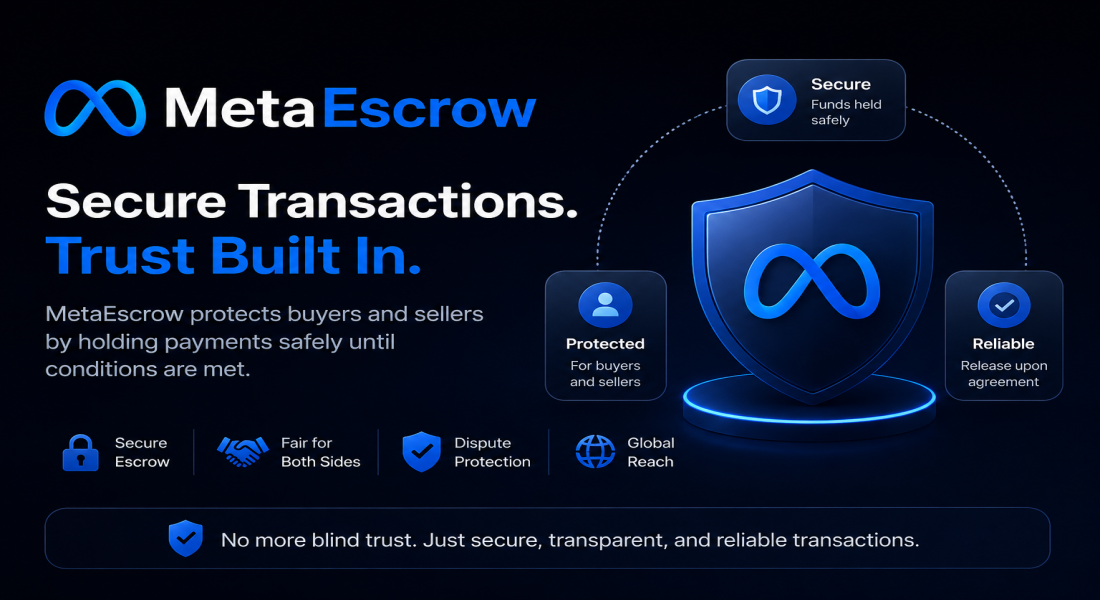
Meta-Escrow: Turning Trust Into a Transaction Process
Meta-Escrow is built around a simple principle:
Trust should not have to come before protection.
For transactions between buyers and sellers, particularly where the parties have never dealt with one another before, escrow introduces a structured layer between agreement and settlement.
Instead of one party assuming the majority of the risk, the transaction can progress through defined stages—from agreement and funding to performance, verification and release.
The objective is not to decide automatically who deserves trust.
It is to make blind trust less necessary.
Because in modern digital commerce, the strongest transaction is not necessarily the one where both parties promise to behave.
It is the one designed to remain secure even when neither party knows the other.
Recent Blogs
-
Buyer Protection Isn't Enough — Sellers Need Protection Too
November 28, 2022 -
KYC Isn't Just Compliance — It's Part of Transaction Trust.
November 28, 2022 -

Shopping Scams Are Dominating Social-Media Fraud
November 28, 2022 -
How Escrow Reduces Risk in Cross-Border Transactions
November 28, 2022