Buyer Protection Isn't Enough — Sellers Need Protection Too
Fraudulent Disputes, Non-Payment and Transaction Evidence: Why Proof Is Becoming as Important as Payment
Digital commerce has removed many of the physical barriers between buyers and sellers. A customer can purchase goods from someone thousands of kilometres away, hire a freelancer they have never met, pay a supplier in another country or complete a high-value transaction entirely online.
But removing distance does not remove risk.
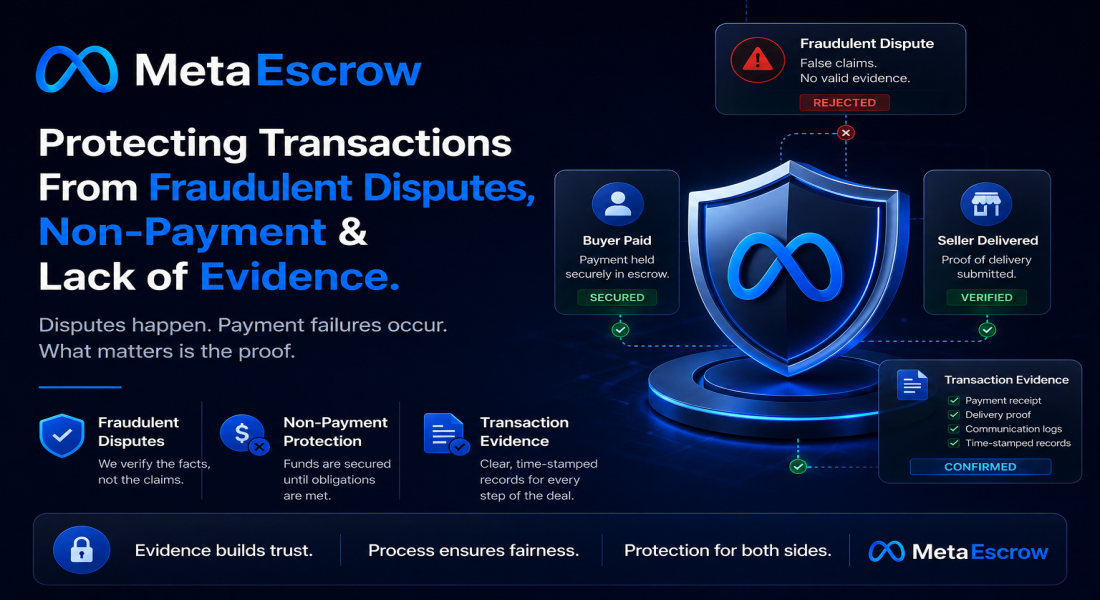
Three problems repeatedly appear when transactions go wrong: fraudulent disputes, non-payment and insufficient transaction evidence.
A seller may complete an agreement only for the buyer to deny receiving what was promised. A buyer may transfer money only for the seller to disappear. Two legitimate parties may disagree because the original terms were never properly documented. And sometimes the truth exists—but neither side has enough evidence to prove it.
This exposes a weakness in ordinary direct payments.
A payment system can prove that money moved from one account to another. It does not necessarily prove why the payment was made, what was promised in exchange, whether those conditions were fulfilled, or which party failed to perform.
That distinction is fundamental to understanding transaction security.
A Successful Payment Is Not Necessarily a Successful Transaction
Consider a simple transaction.
A buyer agrees to purchase equipment for $8,000. The buyer sends the seller $8,000 through a bank transfer. Technically, the payment succeeds.
But suppose the equipment never arrives.
The payment network performed exactly as instructed, yet the commercial transaction failed.
Now consider the opposite scenario. The seller ships the equipment, tracking confirms delivery, and the buyer subsequently disputes the transaction or claims that nothing was received.
Again, payment and transaction integrity become two different things.
A complete transaction contains several separate events:
Agreement → Payment → Performance → Verification → Settlement
Traditional direct payment often concentrates heavily on one of them—payment.
A stronger transaction system needs to preserve information about the entire sequence.
That is where transaction evidence becomes critical.
The Problem of Fraudulent Disputes
Disputes are a necessary part of commerce.
Products can genuinely arrive damaged. Services can genuinely fall below agreed specifications. Packages can be lost. Payments can be processed incorrectly. Sellers can fail to deliver.
Buyers therefore need legitimate mechanisms for challenging transactions.
But the existence of a dispute mechanism creates another opportunity for abuse.
A dishonest buyer can receive legitimate goods or services and subsequently claim that the transaction was not completed correctly.
This can take several forms:
- falsely claiming that goods never arrived;
- claiming that an authorised transaction was unauthorised;
- alleging that a genuine product was counterfeit;
- claiming a service was never performed;
- disputing a payment after consuming a digital product;
- returning a different product from the one received;
- misrepresenting the condition of delivered goods;
- deliberately exploiting weak documentation.
This type of behaviour is sometimes associated with first-party misuse or "friendly fraud."
The word "friendly" makes it sound harmless.
It isn't.
For merchants, the consequences can include lost revenue, lost inventory, dispute fees, administrative expenses and increased payment-processing risk.
The seller can effectively lose twice:
the product and the payment.
Why Fraudulent Disputes Are Difficult to Resolve
A dispute often becomes a battle over evidence.
Suppose a buyer says:
"The seller never delivered."
The seller says:
"I delivered exactly what we agreed."
Who is correct?
Without supporting records, a payment provider or dispute administrator may have little more than contradictory statements.
Now imagine that the transaction contains:
- an agreed product description;
- price;
- timestamp;
- buyer confirmation;
- seller confirmation;
- payment record;
- shipping information;
- tracking number;
- proof of delivery;
- communications;
- photographs or documents;
- completion confirmation.
The situation changes considerably.
The dispute is no longer simply:
Buyer says X. Seller says Y.
It becomes:
What does the transaction record show?
That is a much stronger foundation for dispute resolution.
Non-Payment: The Seller's Version of Transaction Risk
Buyers naturally worry about paying someone who never delivers.
Sellers face the opposite danger:
delivering to someone who never pays.
This is particularly significant for freelancers, contractors, suppliers and service businesses.
Consider a developer hired to build a website for $6,000.
The agreement is informal.
The developer completes four weeks of work.
The client receives the website.
Then payment becomes difficult.
First:
"We'll send it tomorrow."
Then:
"Accounting is processing it."
Then:
"We need to review a few things."
Eventually:
"We're not satisfied with the work."
The developer has already transferred the valuable asset—their labour.
Recovering payment now requires negotiation, debt collection or potentially legal action.
The fundamental mistake occurred before the work began:
payment commitment and performance were not structurally connected.
Why "I'll Pay When You're Finished" Creates Risk
Many service transactions operate on promises.
The seller performs first.
Payment comes later.
This effectively means that the seller is extending unsecured credit to the buyer.
For a $100 job, the risk may be tolerable.
For a $50,000 contract, it becomes much more serious.
The seller must ask:
Does the buyer actually have the funds?
Are those funds committed to this transaction?
Can the buyer change their mind after receiving the work?
What happens if the buyer disappears?
Escrow addresses this problem differently.
Rather than asking the seller to trust a future promise of payment, the buyer can commit funds before performance begins, subject to the agreed release conditions.
That distinction matters.
Promise to pay and funds committed to a transaction are not equivalent.
Buyers Face the Exact Opposite Problem
Now reverse the scenario.
A buyer wants a custom manufacturing order worth $20,000.
The supplier demands full payment upfront.
The buyer transfers the money.
Production never begins.
Or perhaps the seller disappears.
The buyer now faces the same structural weakness previously faced by the seller.
The buyer fulfilled their obligation before the seller fulfilled theirs.
This creates the fundamental dilemma of direct commerce:
Buyer pays first
The buyer assumes substantial counterparty risk.
Seller performs first
The seller assumes substantial counterparty risk.
Neither solution is ideal.
A better system separates committing value from releasing value.
Escrow Changes the Order of Risk
Instead of:
Buyer → Money → Seller → Hopefully Delivery
an escrow transaction can follow:
Agreement → Funds Secured → Seller Performs → Evidence Recorded → Conditions Verified → Funds Released
The difference is substantial.
The buyer demonstrates financial commitment without immediately giving the seller unrestricted access to the money.
The seller gains greater confidence that the buyer has committed funds before surrendering goods or performing substantial work.
Neither party receives everything while the other holds nothing.
That is the core economic logic of escrow.
Transaction Evidence: The Missing Layer of Digital Commerce
Payment is only one type of evidence.
A secure transaction should potentially establish answers to several questions.
Who participated?
What did they agree to?
How much was involved?
When did the transaction begin?
What conditions were established?
Was payment committed?
Did the seller perform?
Was delivery completed?
Was the transaction accepted?
Were the terms modified?
Was a dispute raised?
What evidence supports each party's position?
The answers collectively form what can be thought of as the transaction record.
This record becomes particularly important when something goes wrong.
Evidence Should Begin Before the Dispute
A common mistake is trying to construct evidence after a dispute has already started.
The seller searches through emails.
The buyer searches through screenshots.
Someone tries to find an old WhatsApp conversation.
Another person searches for a bank receipt.
Tracking information may have expired.
Documents are scattered across devices.
Nobody can remember exactly what was agreed.
This is backwards.
Evidence should be generated during the transaction, not reconstructed after it.
Every important transaction event can create a record.
For example:
10:02 — Transaction created
10:05 — Buyer accepts terms
10:07 — Seller accepts terms
10:14 — Buyer funds transaction
14:42 — Seller uploads shipping information
Three days later — Carrier records delivery
Following day — Buyer confirms receipt
Funds released
If a dispute later emerges, the chronology already exists.
What Makes Good Transaction Evidence?
Not all evidence has equal value.
A screenshot can be useful, but screenshots can be cropped or manipulated.
A conversation can provide context, but messages may be incomplete.
A payment receipt proves payment, but may not establish what the payment was for.
Strong transaction evidence combines multiple records.
For example:
Agreement evidence
The transaction should document what both parties agreed to.
That can include product specifications, service descriptions, quantity, price, delivery deadline, milestone requirements, inspection periods and refund conditions.
Payment evidence
The system should record whether funds were successfully committed to the transaction.
Performance evidence
The seller should be able to provide evidence that their obligations were completed.
Depending on the transaction, this might include shipping records, tracking information, delivery confirmation, milestone submissions, uploaded documents or completion records.
Communication evidence
Important transaction-related communication should remain associated with the transaction wherever practical.
Time evidence
Critical events should have reliable timestamps.
Acceptance evidence
Where applicable, the system should record when the buyer accepts delivery or confirms completion.
Together, these records create something far stronger than a simple payment receipt.
They create a transaction history.
Evidence Protects Buyers Too
Transaction evidence should never be designed exclusively for merchants.
Buyers benefit equally from good documentation.
Suppose a buyer purchases a machine advertised as:
Model X, 2025 edition, new condition, including accessories A, B and C.
The delivered machine is an older model and two accessories are missing.
Without documented transaction terms, the seller might argue that the buyer misunderstood the offer.
With clear records, the question becomes simpler:
What was promised?
What was delivered?
Evidence therefore does not inherently favour buyers or sellers.
Good evidence favours verifiable facts.
That is exactly what a neutral transaction system should aim for.
Evidence Can Reduce Opportunistic Behaviour
Transaction design influences behaviour.
When people know that a transaction has poor documentation, opportunistic behaviour becomes easier.
A dishonest participant can simply deny what happened.
But when both parties know that important actions are recorded, the economics of dishonesty change.
The seller knows there will be evidence of whether delivery occurred.
The buyer knows there will be evidence of whether payment was committed.
Both know that agreed conditions were recorded.
Both know that timestamps exist.
Both know that supporting documents may be reviewed if a dispute occurs.
This does not eliminate fraud.
But it raises the cost of making a false claim.
That is important.
Fraud prevention is not only about detecting criminals.
It is also about designing systems where dishonest behaviour becomes harder to execute successfully.
Milestones Make Evidence Even Stronger
Complex transactions should not always be treated as a single event.
Consider a $30,000 software project.
Instead of:
$30,000 → Project → Finished
the transaction could contain milestones.
Milestone 1 — Design — $5,000
Milestone 2 — Development — $12,000
Milestone 3 — Testing — $8,000
Milestone 4 — Deployment — $5,000
Each milestone creates its own agreement, performance event, evidence and payment release.
This dramatically improves clarity.
If a disagreement occurs during stage three, the parties do not necessarily need to dispute the entire $30,000 relationship.
They can identify the specific obligation in question.
Milestones transform a vague commercial promise into a sequence of verifiable events.
Dispute Resolution Should Be Evidence-Led
A credible escrow platform should not promise that disputes will never happen.
They will.
Two honest people can interpret an agreement differently.
Goods can arrive damaged.
Delivery companies can make mistakes.
Technical failures happen.
Deadlines are missed.
The important question is:
What happens when the parties disagree?
A well-designed dispute process should focus on evidence rather than emotion.
Instead of asking:
"Who sounds more convincing?"
the process should ask:
"What were the agreed conditions?"
"What payment was committed?"
"What evidence of performance exists?"
"What does the delivery record show?"
"What communications are relevant?"
"Which contractual condition remains unsatisfied?"
That moves dispute resolution from accusation toward verification.
The Transaction Timeline Becomes a Source of Truth
One of the most powerful features an escrow platform can provide is a coherent transaction timeline.
Imagine opening a disputed transaction and immediately seeing:
Transaction created
↓
Terms accepted
↓
Payment secured
↓
Seller begins fulfilment
↓
Tracking submitted
↓
Delivery recorded
↓
Buyer raises dispute
↓
Evidence submitted
↓
Review completed
This chronology makes complex situations easier to understand.
It also makes retrospective manipulation more difficult.
Instead of reconstructing the transaction from scattered messages and memories, participants can examine the sequence of events.
Why Direct Payments Often Lack Context
A bank statement might say:
Transfer: $4,800
That proves something important.
Money moved.
But it may not prove:
- what product was purchased;
- which model was agreed;
- expected condition;
- delivery deadline;
- refund policy;
- inspection period;
- seller obligations;
- buyer obligations;
- whether delivery occurred.
Payment systems are excellent at recording movement of value.
Escrow systems can add another layer:
the context governing that movement.
That context becomes extremely valuable when the parties disagree.
Transaction Security Is Really About Control
Most people think transaction security means encryption, passwords and fraud detection.
Those are important.
But commercial security also concerns who controls value at each stage of the transaction.
Suppose the buyer controls both the money and delivered goods.
The seller is exposed.
Suppose the seller controls both the buyer's money and the undelivered goods.
The buyer is exposed.
Escrow attempts to prevent either side from obtaining complete unilateral control before the required conditions are satisfied.
The goal is therefore not simply:
protect the money.
It is:
control when ownership of value changes.
That is a deeper concept.
Meta-Escrow: Building Evidence Into the Transaction
For Meta-Escrow, this creates an important product philosophy.
Escrow should not merely be presented as a place where money waits.
It can be understood as a transaction-control layer.
A well-designed transaction workflow can connect:
Agreement
↓
Funding
↓
Performance
↓
Evidence
↓
Verification
↓
Release
↓
Permanent transaction record
Each stage answers a different question.
Agreement establishes what should happen.
Funding establishes whether the buyer has committed payment.
Performance records what the seller did.
Evidence helps establish whether obligations were satisfied.
Verification determines whether release conditions have been reached.
Settlement completes the financial exchange.
And the transaction record establishes what happened afterward.
That is considerably more powerful than simply transferring money from A to B.
Protect the Transaction, Not Just the Payment
Fraudulent disputes, non-payment and insufficient evidence appear to be three separate problems.
Structurally, however, they are closely connected.
They emerge when there is uncertainty about commitment, performance and proof.
Non-payment asks:
Was the buyer financially committed?
Fraudulent disputes ask:
Did the transaction happen as claimed?
Transaction evidence asks:
Can either side prove it?
A properly structured escrow transaction addresses all three.
It establishes commitment before performance.
It controls when funds can be released.
And it creates a record capable of supporting legitimate disputes while making fraudulent claims more difficult.
This changes the role of trust.
Instead of:
"I trust you, therefore I'll take the risk."
the transaction becomes:
"We have agreed to the conditions, the funds are secured, our actions are documented, and settlement follows verified performance."
That is a much stronger foundation for digital commerce.
The Future of Trust Is Verifiable
As more commerce moves online and more people transact with strangers, reputation alone will not be enough.
A profile picture is not proof.
A promise is not proof.
A payment screenshot is not proof of fulfilment.
A delivery claim is not automatically proof of delivery.
And an accusation is not proof of wrongdoing.
Digital commerce needs something stronger:
verifiable transaction history.
For buyers, that means evidence that their money is connected to clearly defined obligations.
For sellers, it means evidence that funds have been committed and that successful performance can be documented.
For both sides, it means disputes can be evaluated against records rather than competing stories.
That is where escrow becomes more than a payment mechanism.
It becomes infrastructure for accountability.
Because the safest transaction is not one where disputes are impossible.
It is one where, if a dispute occurs, the evidence already exists.
Meta-Escrow
Secure the funds. Document the transaction. Verify the outcome. Release with confidence.
Recent Blogs
-
The $16 Billion Trust Problem: Why Online Payments Need a Middle Layer
November 28, 2022 -
KYC Isn't Just Compliance — It's Part of Transaction Trust.
November 28, 2022 -

Shopping Scams Are Dominating Social-Media Fraud
November 28, 2022 -
How Escrow Reduces Risk in Cross-Border Transactions
November 28, 2022