
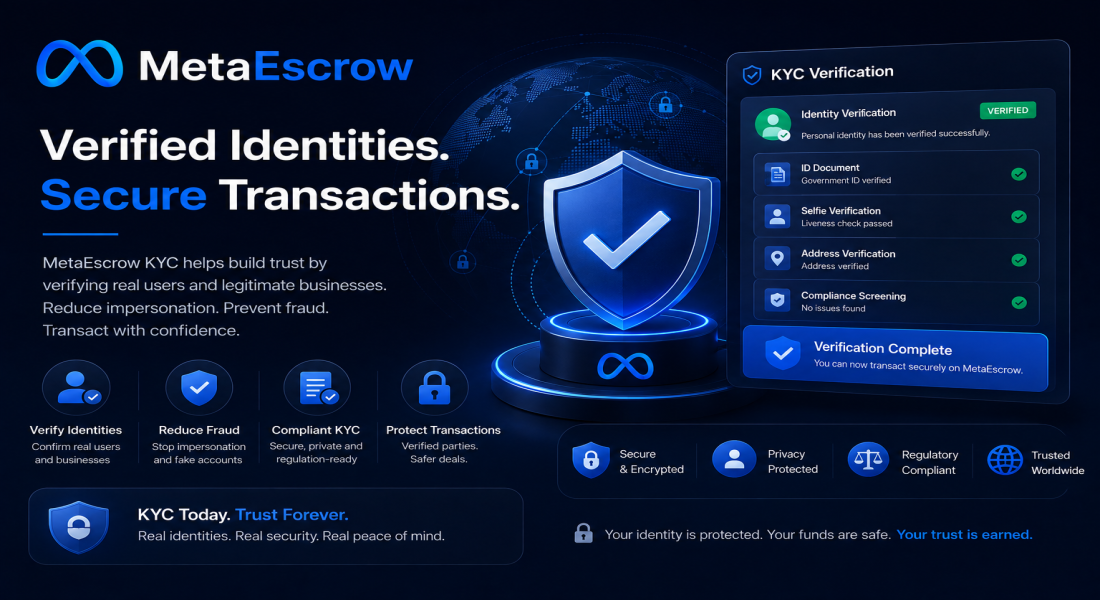
KYC Isn't Just Compliance — It's Part of Transaction Trust.
Identity Verification in Digital Transactions: Reducing Impersonation, Fraudulent Accounts and False Trust
The internet has made it remarkably easy for strangers to transact with one another. A buyer can find a seller through a marketplace, a business can hire a contractor in another country, and two people who have never met can negotiate a high-value transaction entirely through their phones.
That convenience creates a fundamental security problem:
How do you know the person on the other side of the transaction is actually who they claim to be?
A name is not an identity.
An email address is not an identity.
A phone number is not an identity.
A profile photograph is not an identity.
And a professionally designed account does not automatically represent a legitimate person or business.
This is why identity verification has become an important layer of modern digital commerce. When implemented proportionately and securely, verification makes it harder to create disposable fraudulent accounts, impersonate legitimate users and repeatedly exploit transaction platforms under false identities.
For an escrow environment such as Meta-Escrow, identity verification can contribute to a larger objective: making trust increasingly evidence-based rather than assumption-based.
---
The Identity Problem Behind Online Fraud
Many online scams begin before money is ever transferred.
They begin with an identity claim.
Someone claims to be a legitimate seller.
Someone claims to represent a company.
Someone creates an account using another person's name.
Someone compromises an existing account and begins communicating as its owner.
Someone creates several accounts and uses them to manipulate transactions.
Someone pretends to be a trusted professional, supplier or customer.
The eventual payment fraud may only be the final stage.
The fraud began when the victim accepted a false identity as genuine.
This means transaction security cannot focus exclusively on protecting money.
It must also consider who is attempting to control the transaction.
---
Impersonation Turns Reputation Into a Weapon
Ordinary fraud involves inventing credibility.
Impersonation fraud can be more dangerous because the attacker borrows someone else's credibility.
Imagine a successful supplier that has operated for years.
Customers know its name.
The company has genuine reviews and legitimate employees.
A fraudster creates a similar email address, copies the company's branding and contacts one of its customers.
The message says:
> "We've changed our payment account. Please send your next payment here."
The victim is not necessarily trusting the fraudster.
They believe they are trusting the company they already know.
That difference makes impersonation particularly powerful.
The criminal does not need to build trust from zero.
They only need to successfully imitate an identity that already possesses it.
---
Fraudulent Accounts Create Disposable Identities
Another problem is account creation.
If a platform allows anyone to create unlimited accounts with minimal verification, an attacker can treat identities as disposable.
One account gets reported.
Another appears.
The second gets restricted.
A third is created.
This can become a cycle:
Create → Scam → Abandon → Recreate
The individual behind the accounts remains largely unchanged.
Only the digital identity changes.
This weakens account-based security because banning an account does not necessarily remove the person operating it.
Effective identity controls attempt to make this cycle more difficult.
The objective is not merely:
"Is this email address real?"
It is closer to:
"Is there sufficient evidence that a real and appropriately identified person or organization controls this account?"
That is a much stronger question.
---
Identity Verification and Authentication Are Different
These concepts are often confused.
Identity verification asks:
> Who are you?
Authentication asks:
> Are you the person who is authorized to access this account?
They solve different problems.
A platform may verify someone's identity during onboarding and later use passwords, passkeys, one-time codes or multi-factor authentication to protect access to that verified account.
Both layers matter.
Identity verification without strong authentication can still leave an account vulnerable to takeover.
Authentication without meaningful identity controls can securely authenticate a fraudulent account.
A strong system therefore considers both:
Identity assurance + account security.
---
What Identity Verification Actually Does
Identity verification should not be interpreted as a magical declaration that:
"This person can never commit fraud."
That would be unrealistic.
A verified individual can still behave dishonestly.
Verification serves a narrower but extremely valuable purpose.
It increases confidence that certain identity attributes have been checked and makes some forms of anonymity, impersonation and disposable-account abuse more difficult.
Depending on jurisdiction, transaction risk and platform design, verification may involve checking combinations of:
legal name;
date of birth;
government-issued identification;
address or other identifying information;
telephone or email ownership;
business registration details;
beneficial ownership or authorized representatives;
document authenticity;
liveness or biometric checks where lawful and appropriate;
sanctions or other compliance screening where required.
The exact level should be proportionate to the risk.
A small transaction does not necessarily require the same verification controls as a six-figure commercial transaction.
This leads to an important principle:
Verification should be risk-based, not merely bureaucratic.
---
Verification Creates Friction for Fraudsters
Good digital products normally try to reduce friction.
But security introduces an interesting exception.
For legitimate users:
friction should be minimized.
For attackers:
friction should be maximized.
Imagine a fraudster attempting to create 50 accounts.
If creating an account requires only:
Email + password
the cost of creating 50 accounts is extremely low.
Now introduce proportionate identity checks.
The attacker may need to repeatedly produce credible identity evidence and pass additional controls.
The economics change.
The platform is no longer merely asking the attacker to generate another username.
It is forcing them to overcome stronger identity barriers.
Verification therefore works partly through economic deterrence.
Fraud becomes more expensive, slower and harder to scale.
---
Verification Can Reduce Impersonation
Consider two accounts.
Account A
John Smith
Email verified.
Nothing else established.
Account B
John Smith
Identity checks completed under the platform's verification process.
These accounts should not necessarily carry the same trust signal.
Verification allows the platform to communicate something more precise:
Certain identity information associated with this account has been checked.
That does not mean:
Every claim made by this person is true.
It means the identity layer has received additional scrutiny.
This distinction should always remain clear.
Verification must never become a misleading guarantee of honesty.
---
Verification Can Strengthen Buyer Protection
Buyers often carry substantial risk when purchasing from strangers.
Imagine purchasing a $15,000 machine from an unknown online seller.
Without meaningful identity controls, you may know little more than:
Username: IndustrialMachines247
Email: sales@example
Profile: Created three weeks ago
If the seller disappears, identifying the responsible person may become difficult.
Compare that with an environment where the seller has undergone appropriate identity or business verification.
The transaction now begins with a stronger foundation.
Again, this does not guarantee delivery.
That is where escrow and transaction controls remain necessary.
Identity verification answers:
Who appears to be participating?
Escrow answers:
Who controls the money, and under what conditions can it move?
Transaction evidence answers:
What happened?
Together, these layers are considerably stronger than any one of them individually.
---
Sellers Need Identity Protection Too
Identity verification is equally relevant to sellers.
A fraudulent buyer can create significant losses.
They may use false identities.
They may attempt transactions using compromised payment credentials.
They may create multiple accounts.
They may manipulate dispute systems.
They may claim that legitimate transactions were unauthorized.
For higher-risk transactions, establishing stronger identity assurance around buyers can help sellers understand that they are dealing with an account that has passed defined verification controls.
Again, verification is not proof of future behaviour.
It is one component of risk reduction.
---
Identity Verification Can Strengthen Dispute Resolution
Identity and transaction evidence become particularly powerful when combined.
Suppose a transaction is disputed.
Without identity verification, the platform may have:
Account A vs Account B
With stronger controls, the platform may have a more complete transaction record connecting verified or checked identity attributes to the participants, alongside:
accepted transaction terms;
funding records;
communication history;
delivery evidence;
timestamps;
submitted documents;
completion events;
dispute submissions.
The dispute becomes less dependent on anonymous competing claims.
This creates greater accountability.
Participants understand that their actions are attached to a persistent transaction history rather than a disposable username.
That alone can influence behaviour.
---
Verification Should Be Layered
One of the mistakes platforms can make is treating identity as binary:
Verified
or
Not verified
Real-world identity assurance is more nuanced.
A better model can contain several layers.
For example:
Level 1 — Contact Verification
Email address and phone number are confirmed.
Useful, but relatively weak.
Level 2 — Personal Identity Verification
Additional identifying information and suitable identity documentation are checked.
Level 3 — Enhanced Verification
Additional controls may be applied for higher-risk users or transactions.
Business Verification
A company may require separate verification of business registration, authorized representatives and, where required, beneficial ownership information.
The principle is simple:
Greater risk can justify stronger verification.
---
Transaction Size Should Influence Verification
Consider three transactions.
Transaction A: $30
Transaction B: $3,000
Transaction C: $300,000
Treating all three identically may not be sensible.
Risk-based systems can increase verification requirements as transaction exposure increases.
For example:
Low risk
Basic account controls.
↓
Moderate risk
Stronger identity verification.
↓
High risk
Enhanced verification, additional review or supporting documentation.
↓
Unusual or suspicious activity
Further review and appropriate compliance measures.
This allows security to become proportional rather than arbitrary.
---
Business Verification Is Equally Important
Not every Meta-Escrow transaction will necessarily occur between two individuals.
Businesses can transact with:
suppliers;
contractors;
customers;
distributors;
manufacturers;
professional service providers;
other companies.
In these situations, verifying a person's identity may not be enough.
The platform may also need to establish:
Does this business exist?
Is it properly registered?
Who controls it?
Is the person operating the account authorized to act for it?
This is where business verification—or KYB, Know Your Business—becomes relevant.
A person could legitimately prove their personal identity while falsely claiming to represent a company.
Personal verification and business authority are therefore separate questions.
---
Verification Badges Must Be Designed Carefully
Verification indicators can increase confidence, but they can also create false certainty.
Suppose a platform displays:
✓ Verified
Users may interpret that as:
> "This seller is trustworthy."
But the verification may only mean:
> "The platform verified certain identity information."
Those are not the same statement.
A responsible platform should communicate verification precisely.
For example:
Identity Verified
is clearer than:
Trusted Seller
unless the platform actually operates a separate seller-reputation program supporting that claim.
The verification system should communicate what was established, not imply guarantees it cannot provide.
---
Identity Verification Does Not Replace Escrow
This is one of the most important distinctions for Meta-Escrow.
A verified seller can still fail to deliver.
A verified buyer can still raise a dishonest dispute.
A verified business can still become insolvent.
A verified account can potentially be compromised.
Therefore:
Verification ≠ transaction protection.
Verification establishes greater confidence around identity.
Escrow establishes controls around value.
Transaction evidence establishes records around performance.
Authentication protects account access.
Fraud monitoring looks for suspicious behaviour.
Each addresses a different attack surface.
---
Think of Transaction Security as Multiple Layers
A strong Meta-Escrow security model can be understood as several defensive layers working together.
Layer 1 — Identity
Who is participating?
Layer 2 — Authentication
Is the person accessing the account authorized to do so?
Layer 3 — Agreement
What have the parties agreed to?
Layer 4 — Funding
Has the buyer committed the required funds?
Layer 5 — Escrow Control
Under what conditions can those funds be released?
Layer 6 — Transaction Evidence
What happened during the transaction?
Layer 7 — Dispute Resolution
What happens when the parties disagree?
No single layer has to solve every problem.
The strength comes from their interaction.
---
Verification Must Also Protect Privacy
Collecting identity information creates responsibility.
A platform should not collect sensitive information simply because it can.
Verification should follow principles such as data minimization, purpose limitation, access control, encryption, secure retention and appropriate deletion policies, consistent with applicable laws and regulatory requirements.
This creates an important balance.
Users want stronger protection from fraud.
But users also need protection from unnecessary collection or exposure of personal information.
A good identity system therefore asks:
What information is actually necessary to establish the required level of assurance?
Not:
How much information can we collect?
That distinction matters enormously.
---
Identity Data Should Not Be Public by Default
Verification does not mean exposing someone's identity documents to another user.
A buyer generally should not need access to a seller's passport.
A seller generally should not need access to a buyer's driver's licence.
Instead, the platform can perform or facilitate appropriate verification and communicate the relevant result.
For example:
Identity Verified ✓
rather than:
Here is this person's identification document.
This creates a trust layer without unnecessarily exposing sensitive personal information.
---
Verification Should Continue Beyond Registration
Fraud prevention should not end the moment an account passes onboarding.
Accounts change.
Credentials can be stolen.
Behaviour can change.
Fraudsters may patiently age accounts before abusing them.
A mature risk system can therefore consider signals throughout the account lifecycle.
Certain events may justify additional checks, such as:
unusual account changes;
suspicious login behaviour;
sudden transaction-volume increases;
major changes in transaction patterns;
attempts to change critical payout information;
high-risk transactions;
repeated disputes;
abnormal account relationships.
The goal is not constant unnecessary surveillance.
It is recognizing that identity assurance is part of an ongoing risk process.
---
Re-Verification Can Protect Against Account Takeover
Suppose a legitimate seller's account is compromised.
The attacker logs in and immediately changes the payout destination.
If the platform treats successful login as sufficient authorization, the attacker may redirect funds.
A stronger system might require additional verification before sensitive changes.
This illustrates why identity verification and authentication must work together.
The question changes from:
"Did someone log in successfully?"
to:
"Do we have sufficient confidence that the legitimate account holder authorized this high-risk action?"
That is much stronger security reasoning.
---
Identity + Evidence + Escrow Creates Accountability
Now combine the concepts from the broader Meta-Escrow transaction model.
A transaction begins.
The parties have undergone the appropriate level of identity verification.
They establish clear transaction terms.
The buyer commits funds.
The escrow process controls release.
The seller performs.
Evidence is recorded.
The buyer verifies performance.
Funds are released.
A transaction history remains.
The architecture becomes:
Identity → Agreement → Funding → Performance → Evidence → Verification → Settlement
Each step reduces a different category of uncertainty.
Identity reduces uncertainty about who.
Agreement reduces uncertainty about what.
Escrow reduces uncertainty about payment control.
Evidence reduces uncertainty about what happened.
Verification reduces uncertainty about completion.
This is the foundation of a more defensible digital transaction.
---
From Anonymous Trust to Accountable Commerce
Traditional online transactions frequently ask people to make judgments based on superficial signals.
Does the website look professional?
Does the seller sound genuine?
Does the profile have followers?
Does the company logo look legitimate?
Does the person seem trustworthy?
Those signals may be useful, but they are weak security mechanisms.
A safer model gradually replaces assumptions with verification.
Instead of:
"They look legitimate."
we want:
"Relevant identity information has been checked."
Instead of:
"They promised to pay."
we want:
"Funds have been committed according to the transaction."
Instead of:
"They said they shipped it."
we want:
"Delivery evidence has been recorded."
Instead of:
"They said the agreement was different."
we want:
"The original terms are preserved."
This is the movement from trust by appearance toward trust supported by evidence.
---
What Meta-Escrow Should Ultimately Verify
For a transaction platform, the goal should not simply be knowing someone's name.
The deeper objective is establishing confidence around three fundamental questions:
1. Who are you?
Identity verification.
2. What did you agree to?
Transaction documentation.
3. Did you do what you agreed to do?
Transaction evidence and completion verification.
These three questions cover a remarkable amount of transaction risk.
When combined with controlled settlement, they form a strong foundation for safer commerce.
---
Verification Makes Fraud Harder — Not Impossible
No responsible financial platform should claim that identity verification eliminates fraud.
It does not.
Sophisticated attackers can use stolen identities, compromised accounts, manipulated documents, social engineering and other methods.
The purpose of verification is therefore not to promise perfection.
It is to make fraud:
harder to initiate,
more expensive to scale,
easier to investigate,
and, where appropriate and lawful,
more accountable.
That is meaningful progress.
Security does not require eliminating every possible attack.
It requires continually increasing the cost of attacking while reducing the potential damage when attacks succeed.
---
Meta-Escrow: Know Who Is Transacting Before Value Changes Hands
The future of digital commerce will involve increasingly large transactions between people who may never meet physically.
That makes identity infrastructure increasingly important.
But identity verification should not exist in isolation.
For Meta-Escrow, its strongest role is as part of a larger transaction-protection architecture:
Verify identity.
Secure the funds.
Define the agreement.
Record the evidence.
Verify performance.
Release according to the agreed conditions.
The objective is not to demand blind trust from either side.
It is to systematically remove the reasons blind trust was required in the first place.
Because online, almost anyone can create an account.
Almost anyone can choose a convincing username.
Logos can be copied.
Profiles can be fabricated.
Messages can be impersonated.
But when identity verification, account security, transaction evidence and escrow controls work together, pretending to be someone else becomes harder—and successfully turning that deception into financial loss becomes harder still.
Meta-Escrow: Verify the parties. Protect the transaction. Release with confidence.
Recent Blogs
-
The $16 Billion Trust Problem: Why Online Payments Need a Middle Layer
November 28, 2022 -
Buyer Protection Isn't Enough — Sellers Need Protection Too
November 28, 2022 -

Shopping Scams Are Dominating Social-Media Fraud
November 28, 2022 -
How Escrow Reduces Risk in Cross-Border Transactions
November 28, 2022