How Escrow Reduces Risk in Cross-Border Transactions
When Buyers and Sellers Don’t Know Each Other: Solving the Trust, Jurisdiction, Payment and Verification Problem
Global digital commerce has created an unusual economic environment: two people can enter a significant financial agreement without ever meeting, living in the same country or even operating under the same legal system.
A buyer in London can purchase equipment from a seller in Lagos. A company in Toronto can hire a developer in Singapore. A wholesaler in Dubai can negotiate with a manufacturer in another continent. The entire relationship may begin through a website, marketplace, email or messaging application.
The opportunity is enormous.
So is the trust problem.
When buyer and seller do not know each other, four questions quickly emerge:
Can I trust this person?
What happens if they are in another jurisdiction?
When will the payment actually arrive?
How do I know the person or business is who they claim to be?
These questions are connected. Identity uncertainty increases transaction risk. Geographic distance makes recovery more complicated. Payment delays create uncertainty about performance. Weak verification makes impersonation easier.
For escrow platforms such as Meta-Escrow, the opportunity is therefore larger than simply transferring money.
The real challenge is creating a transaction environment in which strangers can safely exchange value despite distance, uncertainty and limited prior trust.
---
The Internet Solved Distance Before It Solved Trust
For most of human commercial history, geography created a natural limit on transactions.
People bought from merchants in their communities.
Businesses developed relationships with nearby suppliers.
Buyers could inspect products physically.
Sellers often knew their customers.
Reputation travelled through communities.
If something went wrong, both parties usually operated within the same legal environment.
Digital commerce changed this.
A seller can now advertise globally.
A buyer can discover that seller within seconds.
Communication is immediate.
Documents can be exchanged instantly.
But the fundamental trust mechanisms that traditionally surrounded commerce do not automatically travel with the internet.
You can communicate with someone 8,000 kilometres away almost instantly.
That does not mean you can instantly determine whether they will fulfil a $20,000 contract.
This creates a gap between communication speed and trust formation.
Escrow exists partly to bridge that gap.
---
The Stranger-to-Stranger Transaction Problem
Consider a buyer purchasing $12,000 worth of equipment from a seller they discovered online.
They have never met.
The buyer asks:
> "How do I know you'll send the equipment after I pay?"
The seller responds:
> "How do I know you're a serious buyer unless you pay first?"
Both positions are reasonable.
Neither party necessarily has fraudulent intentions.
The problem is structural.
The buyer wants delivery before surrendering control of the money.
The seller wants financial commitment before surrendering control of the goods.
Without an intermediary transaction structure, someone has to assume the risk first.
If the buyer transfers $12,000 directly, the seller may temporarily control both:
the $12,000 and the equipment.
If the seller ships before payment, the buyer may eventually control both:
the equipment and the $12,000.
Escrow changes this relationship by introducing a controlled middle stage.
---
Trust Should Not Depend on Who Takes the First Risk
Traditional stranger-to-stranger commerce often becomes a negotiation over vulnerability.
The buyer says:
"You first."
The seller says:
"No, you first."
This is not an efficient foundation for commerce.
The stronger model is:
Neither party should need to give the other complete control first.
An escrow structure can allow the buyer to commit funds while restricting their release until agreed transaction conditions are satisfied.
The seller receives evidence that funds have been committed.
The buyer knows the seller does not immediately receive unrestricted payment simply because the transfer was initiated.
The relationship changes from:
Trust the person
to:
Trust the process.
That distinction becomes increasingly important when the parties have no previous relationship.
---
Different Jurisdictions Multiply Transaction Complexity
Distance is not merely geographical.
It can also be legal.
Imagine a buyer in Country A and a seller in Country B.
The transaction goes wrong.
Immediately, difficult questions can arise.
Which country's laws apply?
Where was the contract formed?
Which court has jurisdiction?
What consumer protections apply?
How can a judgment be enforced?
How expensive would legal action be?
Would pursuing the dispute cost more than the transaction itself?
These questions can become difficult even for sophisticated businesses.
For ordinary consumers and small companies, pursuing a relatively modest international dispute may simply be impractical.
A $3,000 transaction might not justify thousands of dollars in international legal costs.
Theoretically, the injured party may have legal rights.
Practically, exercising those rights may be economically unrealistic.
That gap matters.
---
Jurisdiction Risk Changes the Economics of Fraud
Fraudsters benefit from complexity.
If a victim is nearby, identifiable and operating under the same legal system, pursuing the offender may be easier.
If the transaction crosses borders, recovery can become substantially more difficult.
Different countries may have different:
contract laws;
consumer-protection regimes;
payment regulations;
identity requirements;
data-protection rules;
dispute procedures;
evidentiary standards;
enforcement mechanisms.
Cross-border commerce therefore requires more than simply supporting different currencies.
A platform must think about transaction governance.
What rules govern the transaction?
What conditions control release?
How are disputes handled?
What evidence is preserved?
What information is provided to both parties before they agree?
Escrow cannot eliminate jurisdictional complexity, and it should never be marketed as replacing courts or applicable law.
But a well-designed transaction process can help resolve many disagreements before they become international legal disputes.
---
Prevention Is Often Cheaper Than Recovery
This leads to a powerful principle.
Once money has been transferred irreversibly to the wrong person, recovery can be difficult.
Once expensive goods have been shipped to a fraudulent buyer, recovery can be difficult.
Once a contractor has completed months of unpaid work, recovery can be difficult.
The strongest transaction architecture therefore does not begin with:
How do we recover the loss?
It begins with:
How do we prevent either party from gaining inappropriate control before the agreement is fulfilled?
That is a major philosophical difference.
Escrow is fundamentally preventive.
---
Payment Delays Create Their Own Trust Problem
Not every transaction problem is fraud.
Sometimes the payment is legitimate—but slow.
Cross-border payments can involve several institutions.
Depending on the payment method, currency, banking relationships, compliance requirements and destination, a transfer may encounter processing periods or additional reviews.
This creates uncertainty.
The seller asks:
Has the buyer actually paid?
The buyer says:
The money has left my account.
The seller replies:
It hasn't reached me.
Now the transaction stalls.
The seller does not want to ship.
The buyer does not want to send another payment.
Neither party necessarily knows where the funds are within the payment chain.
This is not necessarily fraud.
It is a state-of-payment problem.
---
Payment Status Needs to Be Visible
Good transaction infrastructure should make payment status understandable.
For example:
Awaiting Payment
↓
Payment Processing
↓
Funds Confirmed
↓
Funds Secured
↓
Seller Performing
↓
Buyer Verification
↓
Release Processing
↓
Completed
This is much more useful than a binary system that simply says:
Paid / Unpaid
Different stages mean different things.
A buyer initiating a transfer is not necessarily the same as funds being received and secured.
Funds being secured is not the same as funds being released.
Funds being released is not necessarily the same as final settlement reaching the recipient's external financial account.
Clear terminology prevents misunderstandings.
---
Payment Delay Is Dangerous When It Is Mistaken for Payment Failure
Suppose a buyer initiates a legitimate payment.
The transfer requires additional processing.
The seller sees nothing and assumes the buyer has not paid.
The buyer sees a debit and assumes the seller is lying.
Trust begins deteriorating.
Messages become increasingly aggressive.
The transaction may collapse even though neither party intended to deceive the other.
Transparency can prevent this.
If both sides can see that the transaction is:
Payment Processing
rather than:
Payment Missing
the psychological dynamic changes.
Transaction visibility is therefore not merely a convenience feature.
It can be a trust mechanism.
---
Never Treat a Screenshot as Settlement
One common weakness in informal transactions is relying on screenshots as proof of payment.
A buyer sends an image saying:
Payment successful.
The seller ships the product.
But screenshots can be manipulated.
Interfaces can be recreated.
Receipts can be edited.
Old transactions can be presented as new ones.
Even a genuine payment instruction may not necessarily mean final settlement has occurred.
A transaction platform should therefore rely on appropriate confirmation from its actual payment infrastructure rather than asking sellers to interpret screenshots.
The principle should be simple:
Do not ship because someone sent a picture of a payment.
Proceed when the transaction system establishes the required funding state.
---
Verification Solves Another Part of the Problem
Even if the payment system is secure, another question remains:
Who is using the account?
A buyer may be communicating with:
a genuine individual;
a legitimate business;
someone using a fabricated identity;
someone impersonating a real business;
an attacker controlling a compromised account;
someone operating multiple fraudulent profiles.
Identity verification attempts to reduce this uncertainty.
The objective is not to declare that verified users are incapable of wrongdoing.
The objective is to increase confidence that relevant identity information has been checked.
That creates accountability.
---
Identity Verification Is Especially Important Across Borders
Local commerce sometimes contains informal identity signals.
You may know the seller's shop.
You may know people who have purchased from them.
You may know where their business operates.
You may be able to visit them physically.
International digital commerce removes many of those signals.
A seller might exist only as:
a username, profile photograph, email address and telephone number.
That is not much identity infrastructure for a $50,000 transaction.
Risk-based identity verification can create a stronger foundation.
Depending on applicable law, transaction type and risk level, appropriate verification may involve checking relevant personal or business information.
The principle is straightforward:
As transaction exposure increases, stronger identity assurance may become appropriate.
---
Business Verification Matters Too
Suppose someone claims:
> "I represent ABC Manufacturing Ltd."
Verifying that person's personal identity answers one question:
Who is this person?
It does not necessarily answer:
Does ABC Manufacturing Ltd exist?
or:
Is this person authorized to represent it?
Business transactions may therefore require another layer of verification.
This is commonly associated with Know Your Business (KYB) processes.
Depending on regulatory requirements and risk, business verification can involve confirming company registration details and relevant authorized representatives or ownership information.
This becomes particularly important for international transactions where the buyer may have no practical way to inspect the company physically.
---
Verification Should Create Confidence Without Creating False Certainty
There is an important danger here.
Platforms should not allow users to interpret:
Identity Verified
as:
This person is guaranteed trustworthy.
Those statements mean different things.
A verification indicator should communicate precisely what has been established.
For example:
Identity Verified
means identity information has passed the platform's applicable verification process.
It should not automatically mean:
Guaranteed Seller
or:
Fraud-Free Account.
Verified people can still behave badly.
That is why verification must operate alongside escrow.
---
Verification and Escrow Solve Different Problems
This distinction is critical.
Identity verification asks:
Who are you?
Authentication asks:
Are you authorized to access this account?
Escrow asks:
Who controls the money and when can it be released?
Transaction evidence asks:
What happened?
Dispute resolution asks:
What should happen when the parties disagree?
These mechanisms should work together.
None replaces the others.
A verified identity without escrow can still take someone's money.
Escrow without adequate identity controls can still attract fraudulent accounts.
Identity and escrow without transaction evidence can still produce difficult disputes.
Transaction evidence without secure account authentication can be undermined by account takeover.
The system becomes strongest when these protections operate as layers.
---
A Cross-Border Transaction From Beginning to End
Consider a hypothetical transaction.
A buyer in Canada wants to purchase specialized equipment worth $25,000 from a seller in another country.
They have never met.
Instead of sending money directly, they use an escrow transaction.
Step 1 — Account and appropriate verification
Both parties create accounts and complete the verification required for their transaction and risk level.
The platform establishes the relevant identity or business information according to its processes.
Step 2 — Agreement
The transaction records:
Product: Specialized industrial equipment
Price: $25,000
Condition: New
Delivery: Agreed destination
Inspection period: Defined in the transaction
Release conditions: Defined before funding
Both parties accept.
Step 3 — Funding
The buyer initiates payment.
The transaction shows the appropriate processing status.
The seller does not need to rely on a screenshot.
When funds reach the required secured state, the transaction status reflects that.
Step 4 — Performance
The seller ships the equipment according to the agreement.
Relevant delivery information is attached to the transaction.
Step 5 — Evidence
Shipping details, timestamps and relevant transaction records are preserved.
Step 6 — Verification
The buyer receives and inspects the equipment according to the agreed terms.
Step 7 — Release
Once the applicable conditions are satisfied, the escrowed funds are released according to the transaction rules.
Notice what happened.
The buyer and seller never needed to become personal friends.
They needed a credible process.
---
The Platform Becomes the Shared Transaction Environment
This is one of the most important concepts for Meta-Escrow.
When two strangers transact directly, they may each operate from different information.
The buyer has their bank receipt.
The seller has their shipping receipt.
Messages exist somewhere else.
The original agreement may be inside an email.
Identification may have been exchanged through another application.
There is no single transaction narrative.
A structured escrow platform can bring critical elements into a common environment:
Participants
Agreement
Payment state
Transaction status
Evidence
Communication or relevant records
Delivery
Dispute
Release
This creates a shared transaction history.
That shared record can dramatically reduce ambiguity.
---
Different Currencies Add Another Layer
Cross-border transactions may also involve currency conversion.
The buyer thinks in one currency.
The seller prices in another.
Exchange rates move.
Fees may be charged by payment providers or financial institutions.
Settlement amounts may differ from expectations if fees and currency handling are not communicated clearly.
Transparency is therefore essential.
Before committing to a transaction, users should understand applicable pricing, supported currencies, fees and settlement conditions.
Hidden uncertainty destroys trust.
Clear information strengthens it.
---
Time Zones Matter More Than They Appear
Even time can create transaction friction.
A buyer sends payment during their working day.
The seller is asleep.
The seller ships an item during their afternoon.
The buyer does not respond for ten hours.
A verification provider may operate under another processing schedule.
A bank may have different processing windows.
What looks like suspicious silence can simply be geography.
Good transaction systems account for this.
Clear timestamps, transaction states, deadlines and notifications help distinguish:
waiting
from:
failure.
This sounds minor.
At scale, it matters.
---
Cross-Border Trust Needs Rules, Not Assumptions
The central weakness of stranger-to-stranger commerce is that both sides begin with limited information.
The buyer does not know whether the seller will perform.
The seller does not know whether the buyer will pay.
Different jurisdictions complicate recovery.
Payment delays create uncertainty.
Identity ambiguity creates opportunities for impersonation.
The solution is not simply asking people to become more trusting.
It is the opposite.
Build systems that require less blind trust.
That means establishing rules before money moves.
---
The Meta-Escrow Trust Architecture
For Meta-Escrow, these concepts can form a coherent transaction architecture:
1. Verify
Establish an appropriate level of confidence around the people or businesses participating.
2. Agree
Document what each party is expected to do.
3. Fund
Allow the buyer to commit funds through the supported payment process.
4. Secure
Control those funds according to the escrow arrangement rather than immediately transferring unrestricted control to the seller.
5. Perform
The seller fulfils the agreed obligation.
6. Document
Relevant transaction evidence is recorded.
7. Verify Completion
The agreed conditions determine whether the transaction has been fulfilled.
8. Release
Funds move according to those conditions.
9. Preserve the Record
The transaction maintains an appropriate history for reference and dispute handling, subject to applicable retention and privacy requirements.
This turns a potentially chaotic transaction between strangers into a structured sequence.
---
Trust Is Better When It Is Distributed
Direct transactions often concentrate trust in one person.
The buyer must trust the seller.
Or the seller must trust the buyer.
A stronger system distributes trust across mechanisms.
You do not rely entirely on the seller because funds are controlled.
You do not rely entirely on the buyer because payment commitment can be established.
You do not rely entirely on someone's profile because appropriate verification can be performed.
You do not rely entirely on memory because transaction evidence exists.
You do not rely entirely on promises because release conditions were defined.
This is what infrastructure does.
It replaces individual uncertainty with structured controls.
---
Escrow Does Not Eliminate Cross-Border Risk
It is important to keep the claim precise.
Escrow cannot eliminate every international transaction risk.
It cannot make incompatible laws disappear.
It cannot guarantee that customs will never delay goods.
It cannot guarantee exchange rates.
It cannot prevent every fraudulent identity.
It cannot guarantee every buyer and seller will agree about product quality.
It cannot make every payment rail instantaneous.
And an escrow provider itself must operate within applicable financial, payments, AML/KYC, consumer-protection, sanctions, privacy and licensing requirements in the jurisdictions where it operates.
The value of escrow is more focused:
It can reduce unnecessary counterparty exposure by controlling how and when value moves.
That is powerful enough without exaggerating it.
---
The Bigger Idea: Commerce Without Prior Relationships
The most valuable outcome is not simply "safe payments."
It is the ability to enable commerce between parties who previously might not have trusted each other enough to transact.
A buyer discovers an excellent supplier overseas.
Previously:
> "I don't know them. I won't send the money."
A legitimate seller discovers a new international customer.
Previously:
> "I don't know them. I won't ship before payment."
The transaction never happens.
A trusted transaction framework changes the calculation.
The parties do not need years of relationship history before doing business.
Instead, they can rely on a structured process combining identity assurance, documented terms, controlled funds and transaction evidence.
This potentially expands the number of economically viable relationships.
That is the deeper value of escrow.
It does not merely protect transactions.
It can make transactions possible that distrust would otherwise prevent.
---
From "Do I Trust You?" to "Do We Trust the Process?"
This is the transition digital commerce needs.
Old model:
Buyer: Can I trust you?
Seller: Can I trust you?
New model:
Both: What protections govern this transaction?
That question is much stronger.
People change.
Promises fail.
Accounts can be impersonated.
International recovery can be difficult.
Payments can be delayed.
But processes can be designed.
Rules can be established.
Funds can be controlled.
Identity can be appropriately verified.
Evidence can be preserved.
Disputes can be structured.
And release conditions can be agreed before either side takes disproportionate risk.
---
Meta-Escrow: Building Trust Across Borders
A buyer should not need to live in the seller's country to feel protected.
A seller should not need years of history with a buyer before considering a transaction.
And neither party should have to gamble the entire value of the transaction simply because they have never met.
The stronger model is:
Verify who is participating.
Define what is being exchanged.
Secure the buyer's financial commitment.
Give the seller confidence to perform.
Track the state of the payment.
Document relevant transaction events.
Handle disagreements through an evidence-led process.
Release funds according to the agreed conditions.
That is how digital commerce moves beyond geography.
Not by pretending distance does not matter.
But by building transaction infrastructure capable of managing the risks that distance creates.
Because the future of commerce will increasingly involve people who have never met, businesses operating across different jurisdictions and payments travelling through complex financial networks.
They do not necessarily need to know each other.
They need a transaction process both sides can understand and rely upon.
Meta-Escrow
Different people. Different places. One protected transaction.
Recent Blogs
-
Buyer Protection Isn't Enough — Sellers Need Protection Too
October 28, 2020 -
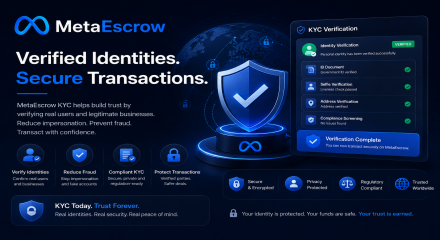
KYC Isn't Just Compliance — It's Part of Transaction Trust.
October 28, 2020 -

Shopping Scams Are Dominating Social-Media Fraud
October 28, 2020